
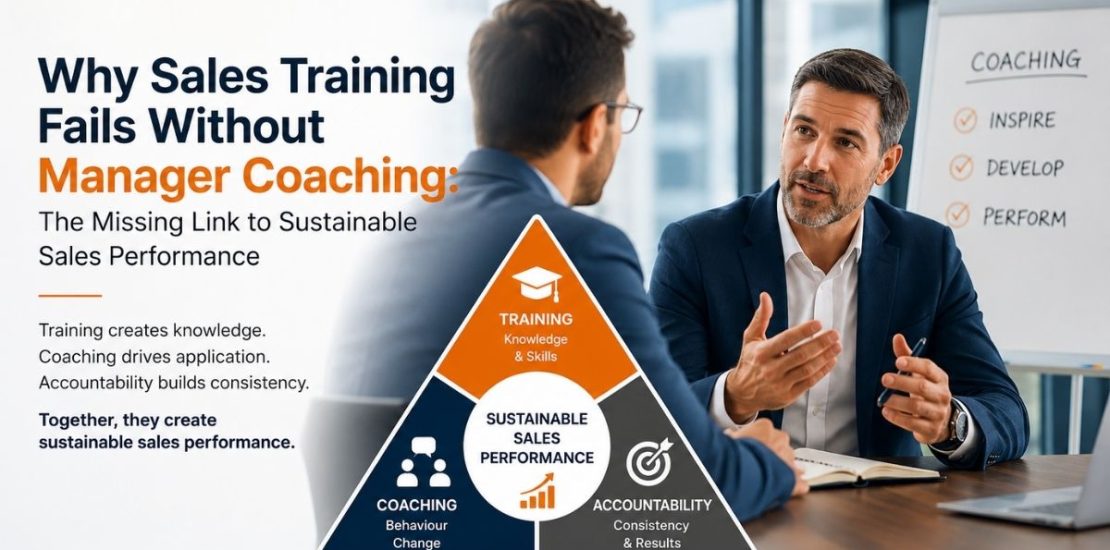
Quick Answer: Sales training often fails because learning is not reinforced after the programme ends. While training introduces new skills, sales manager coaching ensures those skills are applied, refined, and embedded into daily selling behaviours. Organisations that combine training with structured sales manager coaching and accountability achieve higher skill adoption, stronger sales performance, and greater return on training investment.
Why Do Sales Training Programmes Fail?
Every year, organisations invest significant resources in sales training programmes with the expectation of improving sales performance, customer engagement, and commercial outcomes. The training is often well-designed, delivered by experienced facilitators, and supported by proven methodologies. Yet months later, many leaders find themselves asking the same question: why hasn’t performance improved?
The answer is rarely the quality of the training itself. The real issue is that learning is often treated as a one-time event rather than a continuous process. Without reinforcement, sales professionals naturally revert to familiar habits and behaviours. As a result, new skills are forgotten, methodologies are applied inconsistently, and meaningful behavioural change fails to occur.
Research from Objective Management Group found that 85–90% of sales training fails to create lasting behavioural change within 120 days when learning is not reinforced through coaching and accountability.
The Commercial Transformation Triangle™
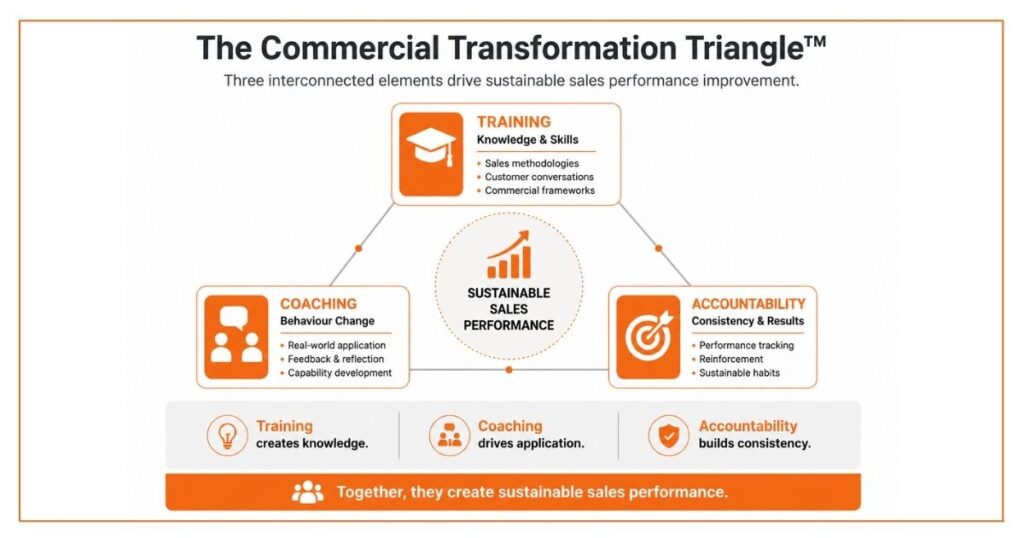
Through years of supporting commercial transformation programmes across MedTech, Healthcare, and Life Sciences organisations, one principle remains consistently true: training alone does not create sustainable performance improvement.
Organisations that invest in both training and sales manager coaching consistently achieve stronger adoption and better commercial results.
Successful organisations build all three components of the Commercial Transformation Triangle™: Training, Coaching, and Accountability.
Most importantly, it creates new knowledge and skills. Coaching helps sales professionals apply those skills in real-world situations. Accountability ensures new behaviours are reinforced and maintained over time. When one of these elements is missing, performance improvement becomes significantly harder to achieve.
Simply put, training creates knowledge, coaching drives application, and accountability builds consistency.
What Is Sales Manager Coaching and Why Does It Matter?
Sales manager coaching is the ongoing process of helping sales professionals improve performance through guided conversations, questioning, observation, and feedback. Unlike traditional management activities, coaching focuses on developing capability rather than simply reviewing results.
Successful sales manager coaching helps individuals develop confidence, capability, and commercial judgement over time.
Effective coaching encourages sales professionals to reflect on customer interactions, challenge assumptions, explore alternative approaches, and strengthen their commercial judgement. It helps individuals learn from their experiences and improve performance over time.
Importantly, coaching is not the same as pipeline reviews, forecasting discussions, or performance inspections. While these activities are valuable management responsibilities, they do not replace the developmental impact of genuine coaching conversations.
Why Sales Manager Coaching Matters More Than Ever?
Today’s sales professionals operate in increasingly complex environments. Across MedTech, Healthcare, and Life Sciences sectors, sales teams must navigate longer buying cycles, multiple stakeholders, increased procurement scrutiny, and growing expectations around value-based selling.
These challenges cannot be solved through training events alone. Sales professionals need ongoing support to apply learning in real customer situations, adapt to changing market conditions, and improve decision-making.
Manager coaching provides this critical reinforcement. It bridges the gap between learning and execution, helping sales professionals transform knowledge into practical skills and measurable results.
Organisations with strong coaching cultures consistently outperform those that rely solely on training initiatives because coaching ensures learning becomes embedded in daily behaviour.
The Sales Manager Coaching Reality Gap
One of the most common findings from coaching maturity assessments is the gap between what managers believe they are delivering and what sales professionals actually experience.
Many managers believe they coach regularly and provide strong support to their teams. However, sales professionals often describe a different reality. What managers view as coaching is frequently experienced as pipeline reviews, deal inspections, forecasting discussions, or administrative conversations.
This disconnect creates what we call the Coaching Reality Gap.
While everyone agrees coaching is important, relatively few organisations consistently deliver high-quality coaching that develops capability and drives behavioural change. Closing this gap represents one of the greatest opportunities for improving sales performance.
Why Sales Manager Coaching Gets Deprioritised
The challenge is rarely a lack of commitment. Most sales managers understand the importance of coaching and genuinely want to support their teams.
The problem is capacity.
Modern sales managers are responsible for forecasting, performance management, internal meetings, strategic initiatives, customer escalations, and organisational change. With so many competing demands, coaching often becomes something managers intend to do rather than something they consistently practise.
Unfortunately, behavioural change does not occur through good intentions. It happens through regular coaching conversations that reinforce learning and support continuous improvement.
Coaching Is a Leadership Skill, Not a Sales Skill
One of the most common misconceptions in commercial leadership is the belief that successful salespeople automatically become effective coaches.
In reality, the skills required are very different.
Top-performing salespeople often excel at influencing customers, negotiating agreements, and closing business. Effective coaches excel at listening, questioning, observing behaviours, and developing others.
This is why coaching capability must be developed intentionally. Organisations that invest in coaching skills training for managers consistently achieve greater adoption of sales training programmes and more sustainable performance improvement.
Real-World Impact: A European Commercial Transformation Programme
During a recent commercial transformation initiative with a leading European medical technology organisation, sales teams faced increasingly complex customer environments characterised by longer sales cycles, more stakeholders, and greater demands for value-based conversations.
While sales training formed a key component of the programme, equal emphasis was placed on developing manager coaching capability. Sales managers participated in dedicated coaching development programmes and were equipped with practical frameworks, tools, and techniques to support ongoing development.
The results reinforced a lesson that many organisations continue to underestimate. The greatest impact did not come from the workshops themselves. It came afterwards, when managers reinforced learning through coaching and helped individuals apply new skills in real selling situations.
Training created awareness. Coaching created behavioural change.
The 4-Step Learning Reinforcement Model™
Sustainable behaviour change follows four stages:
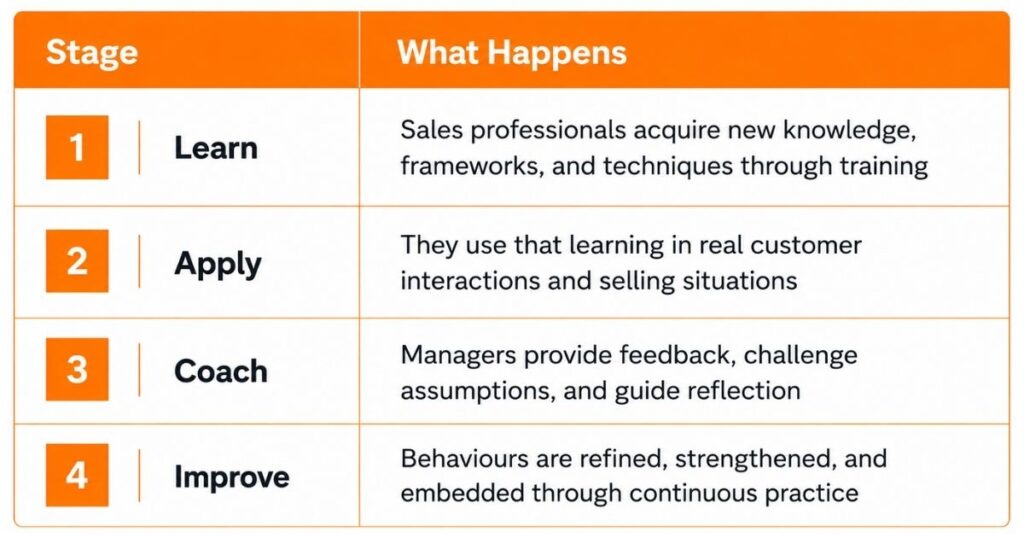
This cycle transforms training from a one-time event into a continuous capability-building process that drives lasting performance improvement.
How High-Performing Organisations Build Sales Manager Coaching Cultures
Organisations that achieve meaningful sales performance improvements treat coaching as a strategic capability rather than an optional management activity.
They establish clear coaching expectations, invest in coaching skills development, create practical coaching frameworks, measure coaching effectiveness, and continuously reinforce learning.
Most importantly, they recognise that coaching is not an additional task. It is an essential leadership responsibility that directly influences commercial performance.
Sales Training vs Sales Manager Coaching: Key Differences
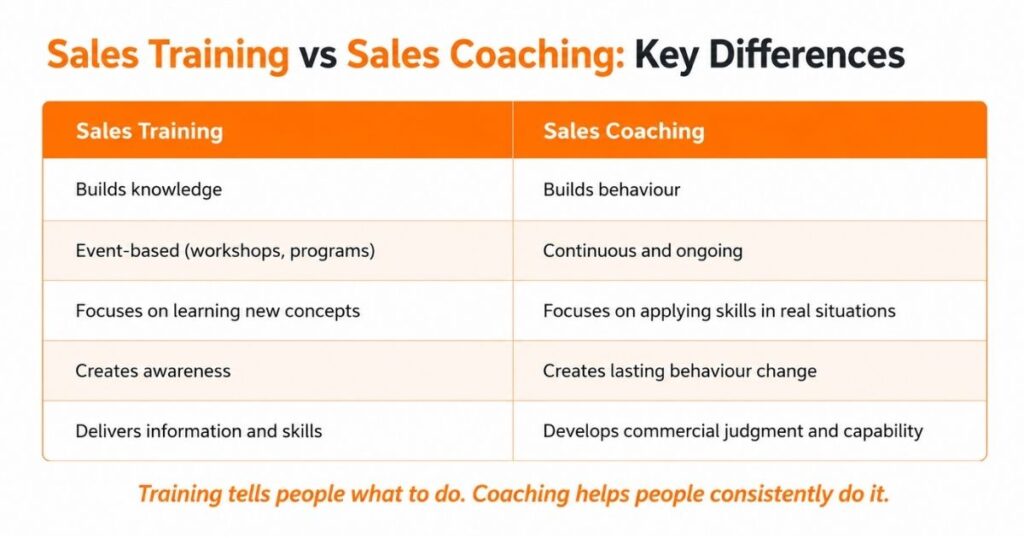
Sales training focuses on building knowledge. Sales coaching focuses on building behaviour.
Training is typically event-based, while coaching is continuous. Training introduces concepts and frameworks, while coaching helps individuals apply those concepts in real-world situations.
Training creates awareness. Coaching creates action.
Both are essential, but sustainable performance improvement only occurs when they work together.
Frequently Asked Questions
Can sales training work without manager coaching?
Yes, but results are often short-lived. Without reinforcement, most sales professionals revert to previous behaviours, reducing the long-term impact of training programmes.
How often should sales managers coach their teams?
The most successful organisations integrate coaching into weekly leadership activities rather than relying solely on formal coaching sessions.
What is the difference between coaching and performance management?
Performance management focuses on results and accountability. Coaching focuses on developing the capabilities that produce those results.
Why do organisations struggle to deliver consistent coaching?
The most common barriers include competing priorities, insufficient coaching skills, lack of structure, and unclear expectations.
Ready to Evaluate Your Coaching Culture?
Many organisations believe coaching is happening consistently, only to discover significant gaps between manager perception and team experience.
At Gyroscope International, our Coaching Maturity Assessment helps MedTech and Life Sciences organisations identify coaching strengths, capability gaps, and opportunities to improve training ROI.
Contact our team to learn how effective manager coaching can transform sales performance and maximise the return on your training investment.